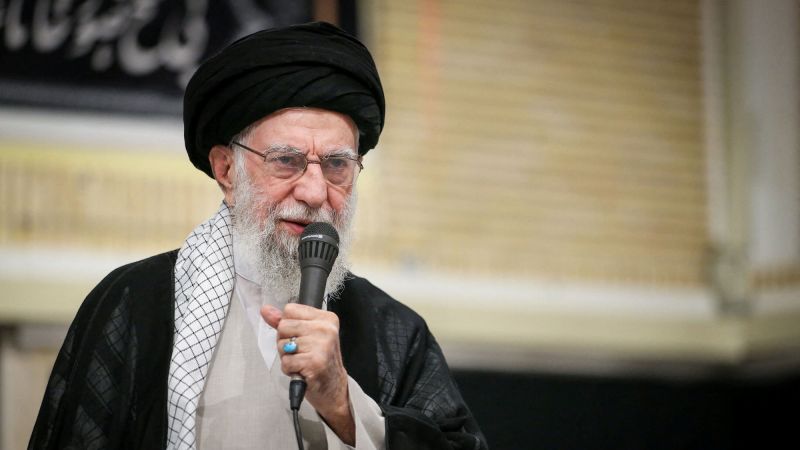
Heightened Tensions: US-Israel Strikes Target Iran Amid Reports of Supreme Leader Khamenei's Death
In a dramatic escalation of geopolitical tensions, the United States and Israel have reportedly launched a series of coordinated military strikes across Iran. The offensive, dubbed "Operation Epic Fury" by the Pentagon, has not only targeted strategic sites but has also been accompanied by unconfirmed, yet explosive, reports regarding the fate of Iran's long-serving Supreme Leader, Ayatollah Ali Khamenei. As the international community grapples with the implications of such a monumental development, the region teeters on the brink of an unpredictable future, with calls for regime change echoing from Washington and Tel Aviv.
A Coordinated Offensive: US-Israel Strikes and Calls for Regime Change
The military campaign commenced with precision strikes across various locations in Iran, including areas reportedly close to the offices of Supreme Leader Ali Khamenei in the capital. Local media outlets swiftly reported nationwide attacks and visible columns of smoke rising from Tehran, indicating the extensive nature of the offensive. This marks the second instance in eight months that the Trump administration has employed military force against the Islamic Republic, signaling a significant shift in strategy.
President Donald Trump, in a video message, confirmed "significant combat operations" were underway and directly appealed to the Iranian populace, urging them to "take the reins of their destiny" and rise against the Islamic leadership that has governed since 1979. This rhetoric was strongly echoed by Israeli Prime Minister Benjamin Netanyahu, who affirmed the joint operation's objective to create conditions for the Iranian people to reclaim control of their nation.
This coordinated offensive underscores a potent alignment of US and Israeli strategic interests in countering Iran's regional influence and nuclear ambitions. The direct appeal to the Iranian people to overthrow their government represents a maximalist approach, betting on internal dissent to reshape Iran's political landscape. For a deeper dive into the immediate aftermath and rhetoric surrounding these strikes, you can refer to our detailed coverage: US & Israel Strike Iran: Trump Urges Regime Change Amid Attacks.
Iran's Swift and Deadly Retaliation
As expected, Iran did not hesitate to respond to what it views as a blatant act of aggression. Fulfilling months of warnings, the Islamic Republic launched a barrage of missiles and drones targeting Israel. Simultaneously, Iranian forces reportedly attacked US military installations in Bahrain, Kuwait, and Qatar, demonstrating the wide reach of its retaliatory capabilities and its willingness to engage multiple adversaries across the region. The immediate and multi-pronged nature of Iran's response highlights the volatile and interconnected dynamics of the Middle East.
Tragically, the human cost of this escalation quickly became apparent. State press reported that shrapnel from an Iranian missile striking the capital of the United Arab Emirates resulted in at least one fatality. This incident serves as a grim reminder of the broader regional risks associated with such conflicts, where unintended consequences can quickly escalate and impact civilian populations far from the primary conflict zones. The rapidity and scale of Iran's retaliation also suggest a prepared and resolute defensive posture, signaling that any further aggression will likely be met with similar force.
The Unconfirmed Report: Supreme Leader Khamenei's Alleged Demise
Amidst the chaos of missile exchanges and military operations, an extraordinary development sent shockwaves across the globe: reports of the death of Iran's Supreme Leader, Ayatollah Ali Khamenei. President Trump made a striking assertion on his Truth Social platform, declaring, "Khamenei, one of the most evil people in history, died. This not only is justice for the Iranian people but for all Americans and people of many countries around the world who have been killed or maimed by Khamenei and his band of bloodthirsty thugs." Trump further posited that this event presented "the greatest opportunity for the Iranian people to take back their country."
Adding weight to these claims, Reuters, citing a senior Israeli official, reported that the body of Supreme Leader Ali Khamenei had been found lifeless. However, it is crucial to emphasize that no official confirmation has yet emerged from Iranian authorities regarding the Supreme Leader's condition or whereabouts. Prior to the Reuters report, Israeli Prime Minister Netanyahu had also alluded to indications of Khamenei's potential death without explicitly confirming it, stating there were "many indications" that the Supreme Leader "is no longer."
The implications of Khamenei's death, if confirmed, would be monumental. As the second Supreme Leader since the 1979 Islamic Revolution, Khamenei has wielded immense power, shaping Iran's domestic and foreign policies for decades. His demise would plunge Iran into an unprecedented succession crisis, potentially creating a power vacuum and significantly altering the trajectory of the Islamic Republic, a nation currently facing what analysts describe as an "existential test." The phrase 'eeuu ataca irán' has been widely used to describe these unfolding events, capturing the urgency and significance of this joint military action.
Operation "Epic Fury": Trump's Strategic Outlook and Exit Routes
President Trump's administration has carefully articulated its approach to the conflict, even as the military operation, christened "Epic Fury," unfolds. In an interview with Axios, Trump outlined several potential "exit routes" for the joint US-Israel attack. He suggested a spectrum of possibilities, ranging from a prolonged engagement to "take control of everything" to a swift withdrawal "in two or three days."
Trump's statement, "I can prolong it and take control of everything, or finish it in two or three days and tell the Iranians: 'See you again in a few years if you start rebuilding (your nuclear and missile programs),'" underscores a flexible yet determined strategy. He confidently predicted that Iran would require "several years to recover from this attack," irrespective of the chosen path. This strategic flexibility aims to keep Iran guessing while ensuring significant long-term damage to its military and nuclear capabilities. The military actions represent a calculated effort to degrade Iranian assets and prevent any future resurgence of perceived threats.
The White House's objective appears to be two-fold: immediate neutralization of specific threats and long-term deterrence through a show of overwhelming force and a clear warning against future nuclear or missile proliferation. For a more detailed look at the strategic options and potential outcomes discussed by the administration, our article Epic Fury in Iran: Escalation, Retaliation & Trump's War Options offers further insights.
Analyzing Regional Ramifications and Future Prospects
The reports surrounding Supreme Leader Khamenei's death, though unconfirmed by Tehran, introduce an extraordinary layer of uncertainty and potential volatility into an already precarious regional landscape. If his passing is verified, the process of succession could be contentious, potentially leading to internal power struggles within Iran's ruling elite. This internal focus might either weaken the regime's external posture or, conversely, lead to more aggressive actions to consolidate power and demonstrate strength.
The call for the Iranian people to "take back their country" by Trump and Netanyahu suggests a strategy banking on internal unrest. Historically, moments of leadership transition in authoritarian regimes have often been catalysts for significant political shifts. The coming days will reveal whether the current military pressure and the unconfirmed death of its supreme leader will ignite widespread dissent within Iran, or if the regime will manage to maintain control and rally support against external threats.
The international community will be closely watching for signals of stability or further fragmentation within Iran. The stability of the wider Middle East, including oil markets and global alliances, hangs in the balance. The immediate term will likely be characterized by intense diplomatic efforts to de-escalate, while regional actors will undoubtedly reposition themselves in anticipation of potential shifts in Iran's internal dynamics and foreign policy. The situation remains fluid, with profound implications for peace and security in one of the world's most critical regions. The term 'eeuu ataca irán' has become a shorthand for this pivotal moment in international relations, signifying a dramatic shift in the geopolitical landscape.
The confluence of coordinated US-Israel strikes, Iran's rapid retaliation, and the unverified reports of Supreme Leader Khamenei's death has plunged the Middle East into an unprecedented state of uncertainty. While Washington and Tel Aviv champion the prospect of an internal uprising, the world awaits official confirmation from Tehran, which remains conspicuously silent on the fate of its paramount leader. The coming days will be critical in determining whether these events mark a turning point towards significant geopolitical restructuring or merely a dangerous escalation in a long-standing regional rivalry.